
Every decade or so, a category that everyone assumes is “done” gets quietly reinvented. Not through a moonshot, but with a subtle shift in what the product is expected to deliver.
We have seen it before. Detergent went from powder to liquid and unlocked 18x growth in 12 years. Sunscreen, once an occasional travel buy, became a daily urban essential, growing at a 77% CAGR on Nykaa and projected to reach $1.4 billion in market size by 2033. In each case, the right form factor unlocked outsized value.
We believe wash-care is next.
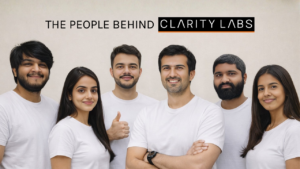
When we met Karan Dokras, founder of Clarity Labs, he didn’t talk about disrupting the skincare industry. He talked about soap. Specifically, why the most mundane product in personal care might also be the most underexploited.
He made a simple observation. Over the last few years, Indian consumers have been sold increasingly complex skincare routines. While most abandon these multi-step routines, nobody skips a shower. If you embed dermaceutical-grade actives into that daily habit, you can deliver real outcomes that compound over time.
At Artha Venture Fund II, we have spent over one and a half decades backing founders who spot leverage where others see commodity. Not by inventing entirely new categories, but by re-thinking what familiar products could do. We are investing ₹3 crore in seed funding, with participation from marquee investors. This decision is guided by our SCOUT^e framework.
How We Found Clarity Labs
Anirudh was introduced to Karan through Artha’s strategic advisor. Once our deal team – led by Anirudh and Rajul, with Sagar as deal associate – engaged with Karan, 2 things stood out.
First, Karan’s depth of operating experience in consumer brands was not theoretical. He had lived through the unglamorous realities of scaling FMCG businesses in India. This was someone who knew what breaks at scale, and more importantly, what prevents things from breaking.
Second, we resonated with the problem Clarity Labs was tackling – this was not about entering a crowded market with yet another serum. It was about reframing the most universal daily habit as a vehicle for functional skincare outcomes.
We have seen too many pitches in the Indian Beauty and Personal Care (BPC) that amount to “we have better ingredients” or “our packaging is more Instagrammable.”
Clarity Labs’ thesis was different.
It was about format, habit, and the magic of compounding – not just formulation. The insight is not that consumers need better actives. It is that the best active in the world is the one that actually gets used every day.
Solve Real Problems
To understand why Clarity Labs exists, you must understand a peculiar paradox in Indian personal care. India’s BPC market is valued at approximately $31 billion and is on course to reach $48 billion by 2034. Per-capita spending has risen, but at $14, it remains a fraction of China ($38) and the United States ($313). The headroom is enormous.
Yet within this expanding market, something counterintuitive has happened. Skincare routines have become more complex, more expensive, and more exhausting – without proportionally better outcomes for most people who use them.
Over the past few years, the “10-step routine,” popularized by influencers and ingredient-led brands, has become aspirational for many but sustainable for few. Serums and treatments work, but they require discipline, consistency, and a monthly budget that often exceeds ₹2,000. For the upper-middle-income consumer, the fastest-growing segment of India’s online beauty market, this creates a frustrating trade-off. The outcomes they want are available, but the effort and cost to sustain them are not.
Meanwhile, the one product these consumers use every single day without thinking has remained stuck in an older paradigm. Traditional soaps are optimized for sensory cues: lather, fragrance, the tight “squeaky clean” feeling that generations of marketing have taught us to associate with cleanliness. In practice, many of these formulations use high-pH surfactants that strip the skin barrier, worsen dryness, and trigger rebound oiliness. The consumer then spends money on creams and serums to repair what the cleansing step broke.
There is another gap hiding in plain sight. Body care has lagged significantly behind face care. While face care has benefited from ingredient-led brands and sophisticated routines, body care has largely stayed within older paradigms – despite persistent concerns such as back acne, pigmentation, texture, and the universal irritation by hard water across much of India.
Clarity Labs starts here.
Instead of selling one more step, the brand embeds mild actives into the products consumers use daily. The per-use impact may be lower than a concentrated serum, but the format ensures consistency. Over time, consistency compounds into meaningful results.
In a market where overclaiming has become endemic, a brand that sets realistic expectations and then consistently meets them has a genuine path to building trust and repeat purchase behavior.
One less step. Every day.
Category Winners with Strong Moats
India’s BPC landscape has evolved in clear waves, each producing its own set of winners.
- Incumbent Era (pre 2017): Legacy brands like Lux, Lifebuoy, Dove, Pears, and Dettol won on distribution, recall value, and emotional branding. Innovation meant line extensions, not formulation breakthroughs.
- Digital Native Phase (2017 – 2021): Brands like Mamaearth, WOW Skin Science, mCaffeine, and Plum reframed the category around specific problems. They leveraged direct consumer relationships.
- Active-led Fragmentation (2022 onwards): The market is split into micro-categories – acne, barrier repair, pigmentation, scalp health. Brands like Minimalist, The Derma Co, Dot & Key, and Foxtale have advanced ingredient-led narratives. But in doing so, they have also contributed to the very stepification that now exhausts consumers.
Clarity Labs sits on the other side of this trend. Rather than adding another step to the routine, it compresses outcomes into a format that already exists in every consumer’s day.
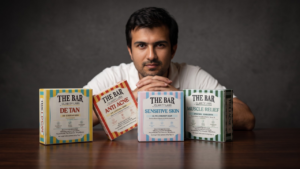
The first sub-brand, “The Bar by Clarity Labs,” launches with 4 variants:
In personal care, moats compound over time through habitual use, consistent outcomes, repeat-purchase behavior, and distribution depth, among other factors. Clarity Labs is starting where these moats are strongest: daily use. Building depth before breadth.
The competitive landscape falls into three broad buckets:
- Functional cleansing: Cetaphil, Kozicare, and Sebamed.
- Active-led portfolio: Minimalist, The Derma Co, and Foxtale
- Scaled legacy brands: HUL, ITC, and P&G
Clarity Labs sits at the intersection, combining the accessibility of wash care with the ingredient credibility of active-led brands at a price point the mass-premium consumer can sustain.
Optimized Unit Economics
Clarity Labs is positioned in the “masstige” segment – priced above commoditized soaps, but below premium dermaceutical skincare. At ₹125 per 75g bar (introductory price), a pack of four retails at ₹599 MRP, selling at ₹499 after discounts. This allows the brand to balance consumer affordability with margin expansion.
The format itself is an advantage. Compared to liquid alternatives, bar wash-care delivers higher longevity per use. On a per-use basis, this translates into a more economical option for consumers, reinforcing both utility and price-value perceptions.
Better unit value for the user. Stronger unit economics for the business. While early contributions may be impacted by channel costs and customer-acquisition investments, the underlying unit economics remain structurally sound.
Unmatched Right to Win
In early-stage investing, the founders are the thesis. This is where our conviction in Clarity Labs is the strongest.
The origin story itself was compelling in its simplicity. A friend of the founder was dealing with hard water – high mineral content reacting with regular soaps to form residue that clogged pores and dulled skin. Expensive creams made it worse because the root cause wasn’t being addressed.
Switching to a pH 5.5 syndet bar solved the problem without any follow-up serum.
That was the first “wait, this is backward” moment – the realization that skincare routines were getting more complex while the biggest leverage sat in the most universal habit.
Karan Dokras is a founder built for execution. He previously built and exited Chymey Teas, scaling it to ₹40 crore ARR in under 4 years. At GlobalBees, he operated at scale. He managed ₹300 crore in annual procurement across 40+ brands, built supply infrastructure including 6 regional distribution centers, and oversaw compliance for 5,000+ SKUs across India and international markets.
Beyond the headline numbers, his most notable achievement was taking Kozicare from ₹10 lakh per month to ₹10 crore per month in 18 months. This combination of operational discipline and growth velocity is rare among Indian consumer businesses.
Tech-Enabled, Not Tech-First
Clarity Labs is not a technology company, and it makes no pretense to be one. It is a consumer brand that uses technology to move faster and execute better.
The team plans to deploy an AI-driven consumer insights tool that mines search keywords, reviews, buyer motivations, and feedback themes. In parallel, technology will standardize repeatable execution levers: optimized marketplace listings, performance marketing iteration, and AI-assisted creative generation.
Technology is an enabler of speed and cost discipline, not a moat. It becomes defensible only when it translates into improved conversion, better retention, and lower CAC over time. Until then, it is a tool for discipline, and not differentiation.
Exponential Scale Potential
The opportunity sits at the intersection of market expansion and behavior shift. India’s BPC market is approximately $31 billion, with a $2 billion segment in skin and body care. Within this, Clarity Labs is targeting a $60 million opportunity in the functional, active-led wash-care.
But the more important shift is on the demand side:
- Upper-middle-income households are projected to grow from 11.5 crore to 16.8 crore by 2030.
- The high-income cohort is expected to grow from 1.8 crore to 2.9 crore.
- Digital consumption is accelerating.
E-commerce penetration in BPC is expected to increase from 8% in FY20 to 20% in FY25, and to 34–38% by FY30. Quick commerce is emerging as a breakout channel, rising to 30–40% of online sales by FY30. For a low-ticket, high-frequency product like soap, these are structural tailwinds.
There is also a clear signal from the market.
The Minimalist acquisition by HUL at approximately ₹2,955 crore, for a brand that scaled to ₹500+ crore ARR in just 4 years, shows strategic buyers are willing to pay meaningful premiums for scaled, science-first digital brands.
Clarity Labs is building towards that scale with a focused roadmap. The portfolio extends beyond soap bars to include body wash, face wash, sunscreen, and teen personal care products. Over the next 18 months, the brand plans to scale to 18–20 SKUs.
The GTM strategy reflects the same discipline. Instead of relying solely on performance marketing, the brand is leveraging non-beauty influencers across fitness, wellness, travel, and yoga. They are building top-of-funnel awareness through nano- and micro-influencers, primarily using paid channels for conversion.
This creates a more capital-efficient acquisition model, with stronger long-term retention potential.
Due Diligence: What We Validated and What Keeps Us Honest
Clarity Labs aligns with a conviction we have been building at Artha:
The next wave of enduring consumer brands in India will not add complexity – they will remove it.
India’s BPC market sits where China’s was in the mid-2000s – at the cusp of a structural shift from unorganized to organized retail, from basic personal care to functional beauty, and from mass to masstige and premium.
As GDP per capita expands from $2,700 to $5,500 by 2030, per-capita BPC spend is projected to move from $15 to $50.
A 3x expansion that will benefit masstige brands.
What we validated:
- Excellent founder-market fit.
- Manufacturing partnerships with credible, execution-ready operators.
- Benchmarked against comparable early-stage BPC investments.
What we are watching closely:
- Repeat rates and cohort behavior.
- Customer sentiment and complaints.
- Return rates as a proxy for product market fit.
- Whether traction is product-led or spend-led.
Beyond capital, our role is to accelerate what typically slows early consumer brands down. Through our network, we aim to unlock access to marketplace leadership teams, quick commerce platforms, and modern trade networks. Our role includes holding the team accountable for tranche milestones and ensuring portfolio expansion follows evidence of repeat and supply stability.
Closing Reflections
At its core, Clarity Labs is making a bet that most people would overlook.
That a humble bar of soap can be reinvented as a vehicle for functional skincare outcomes. That using what people already do, rather than asking them to do more, can expand the addressable market for science-backed personal care in India.
This is not a bet on disruption. It is a bet on integration. On embedding value into an existing habit so seamlessly that the consumer barely notices the upgrade, even as the outcomes compound.
The next 12 months will be definitive.
Commercial launch, early reviews, repeat behaviour, and supply chain stability – each of these will either confirm or challenge our thesis. We enter this partnership with high conviction in the team, clear-eyed awareness of the risks, and a structured approach to capital deployment that ensures we invest in evidence, not just enthusiasm.
We are excited to partner with Karan Dokras on the journey ahead.